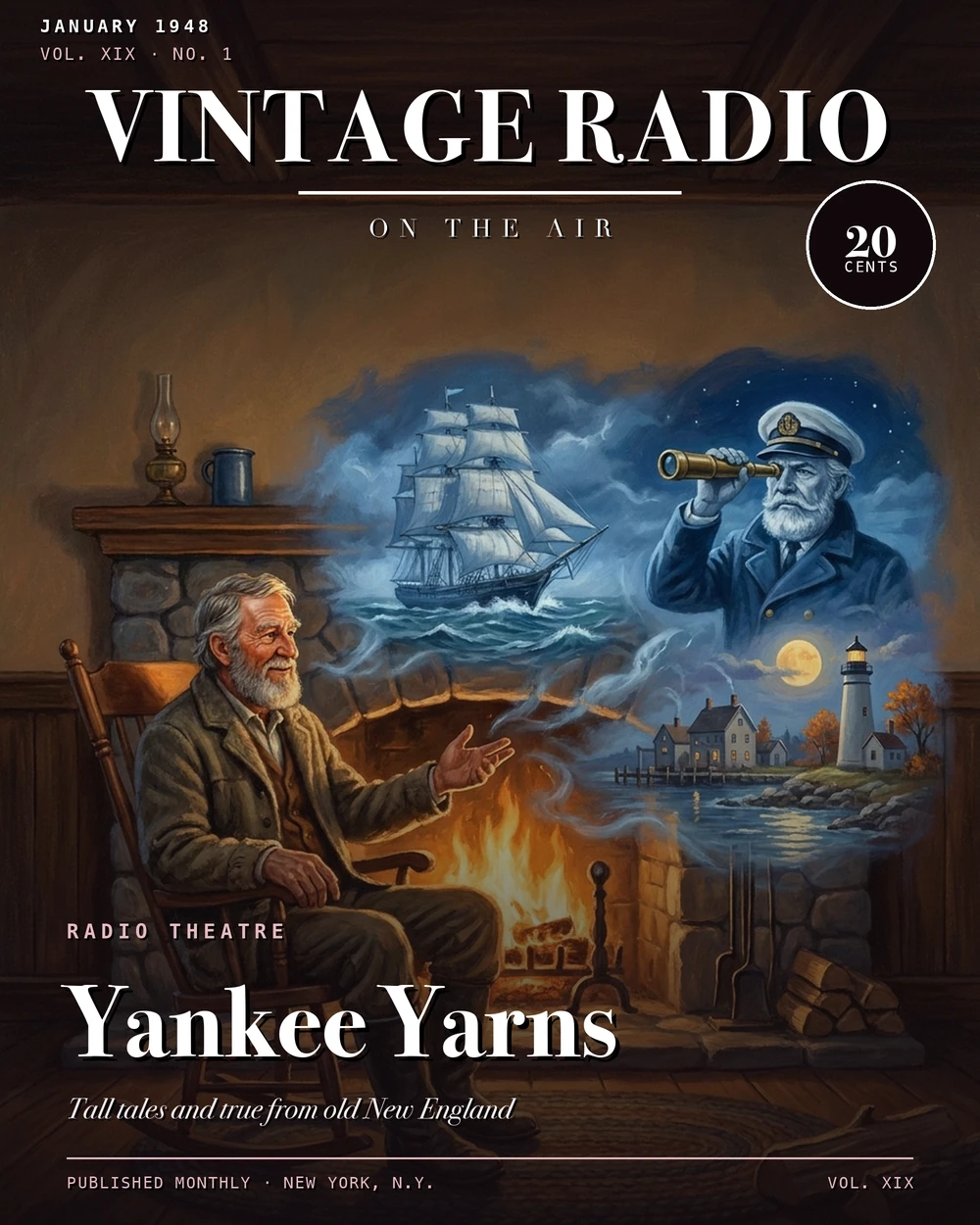
Yankee Yarns
The Man Behind the Stories
Yankee Yarns was built around one man's lifelong love affair with New England — and that man was Alton H. "Blackie" Blackington, a native of Rockland, Maine, who spent decades collecting the region's strangest, funniest, and most haunting stories before he ever spoke a word into a microphone. His tales were described as "alternately amazing, eccentric, horrifying and comical" — a range that goes well beyond the cozy fireside storytelling the title might suggest. Horror sat alongside humor. The eccentric rubbed elbows with the admirable. That tonal width was the point.
Blackington came to radio through a long road. After serving in the Navy during World War I, he joined the staff of the Boston Herald, where he built a reputation writing human interest features on New England people and customs. From there he moved onto the lecture circuit, and it was his popularity as a public speaker that first caught the attention of WNAC and WEAN radio. In 1933 those stations offered him a weekly show, and Yankee Yarns was born. He described himself without any apparent false modesty as "a dyed-in-the-wool Yankee," and a 1937 WNAC promotional blurb called him "an authority on little-known New England stories." That framing — not the host as entertainer, but as keeper of a regional tradition — stayed with the show for its entire run.
How It Grew
Starting on WNAC and WEAN, the show eventually moved to WBZ Boston, the NBC-affiliated station, and found a wider audience through NBC network affiliates. The program ran in some form from 1933 all the way to 1953, a span of two decades that included a transition from radio to television on NBC. The surviving audio covers 1943 to 1951, with 52 known episodes in the catalog, and the earliest preserved broadcast dates to March 8, 1943.
The format was straightforward: Blackington narrated, and the storytelling was supported by musical interludes and a soundtrack designed to set the mood for each tale. The structure wasn't complicated, and it didn't need to be. The draw was the material — stories that ranged from eccentric historical figures to outright ghost tales — and the voice bringing it to the audience. Episodes like "Ghost Story," "Morley's Steamboat," and "Schooner Lawson" suggest the range of subject matter: maritime history, local hauntings, the kind of stories that get passed from neighbor to neighbor in small New England towns and change a little with each telling.
What the Stories Were About
The episode titles alone give a sense of where Blackington went looking. "President Grant's Cigar" and "Old Homestead" sit alongside "Ann Story and Children" and "Coast County Pioneers," suggesting that the show covered everything from famous brushes with history to quieter portraits of ordinary New England life. "Cleopatra's Barge" points toward the kind of subject Blackington clearly enjoyed: a vessel with a name odd enough to stop you mid-sentence, attached to a story most listeners would never have heard.
Some of the stories drew on events that had already become part of the region's lore. The 1919 Great Molasses Flood, in which a massive storage tank in Boston's North End ruptured and sent a wave of molasses through the streets, was exactly the kind of story the show was built for — genuinely strange, rooted in documented history, and almost impossible to believe if you hadn't looked it up. Lord Timothy Dexter of Newburyport, the eccentric merchant whose name turned up again and again in New England tall tales, fit the same mold: a real person whose life story sounded invented but wasn't. These weren't manufactured tall tales. They were real, and that was part of what made them work.
The Peabody and the Books
In 1948, Yankee Yarns received a Peabody Award — the most respected recognition in American broadcasting at the time. The honor confirmed what listeners in the region had already decided: this was something worth paying attention to. By that point the show had been running for fifteen years, and the recognition acknowledged both critical and popular success.
The audience response also took a more tangible form. Listener demand for scripts ran so high that Blackington eventually put the material into print. He published Yankee Yarns through Dodd, Mead & Company in 1954, followed by More Yankee Yarns in 1956. The fact that a radio show generated enough written interest to produce two hardcover books says something about the hold the material had on its audience — these weren't just programs people enjoyed once on a Tuesday night. They were stories people wanted to return to.
A 2021 academic work, Yankee Yarns: Storytelling and the Invention of the National Body, takes the radio program as a twentieth-century example of the Yankee storytelling tradition, placing Blackington's work in a longer lineage of how New England identity has been constructed and transmitted through oral narrative. Whether or not that framing would have amused Blackington — who was, by all indications, more interested in a good story than in cultural theory — the scholarly attention reflects how seriously the show's approach to regional lore has been taken.
How It Ended
The last known radio broadcast of Yankee Yarns aired October 7, 1951, but that wasn't quite the end of Blackington's run with the material. The show transitioned to NBC television, continuing in some form until 1953. Blackington himself lived until 1963, which means he spent the final decade of his life in a world where the radio version of his show had already passed into history. The books he published in 1954 and 1956 were, in part, a way of keeping that history accessible — pulling the stories off tape and putting them on a shelf where anyone could find them.
The 52 surviving radio episodes represent a fraction of what the show produced across nearly two decades of weekly broadcasting. What remains covers a wide enough range — ghost stories, historical portraits, maritime tales, eccentric characters — to give a real sense of what the program was doing and why it earned the reputation it did. Blackington spent his career insisting that the best New England stories were the ones that actually happened, and the surviving episodes make a reasonable case that he was right.